Coach, we often hear this expression in France: ‘Love lasts three years.’ That’s often true for coaches as well, but not in your case!
“I hope that’s not true, that love doesn’t last just three years! This is the first time in my coaching career that this relationship has lasted so long. It’s not easy to stay at a club for two, three or four years. You’re constantly switched on, always preoccupied with preparing the team and everything that’s important to them. I remember there are times when I try to take a step back, to reflect, but it’s difficult. You win a match and, ten minutes later, you’re already thinking about the next opponent, about their strengths and weaknesses.
"When the opponent is very strong, it’s an extra source of motivation. But there’s always the fear of losing, of not performing well. That’s what’s difficult for me to manage as a coach, and that’s why it’s tricky to stay in one place for a long time. But Paris is different; Paris is special. What we’ve experienced here right from the very start has been very special to me. That’s why we’re carrying on, why we’re striving to improve."
So it was a combination of human, sporting and personal factors that convinced you to stay?
“Absolutely. There’s the trust of the Club, the chairmen and Luis Campos. The connection with Luis Campos, right from the very start, has been very special. It’s a wonderful relationship. We’re all in this together; we’re striving to improve even further, to enjoy what we do and to make our supporters happy. Ultimately, that’s the most important motivation.”
When you first arrived at the club, you already spoke of the importance of trust in being able to work with peace of mind. Looking back, what enabled you to forge that connection in Paris?
“It is precisely that trust that allows me to work as a manager. I remember something I said when I was in charge of the Spanish national team. I don’t know what the result will be and after several years coaching I know we’re going to lose matches. We might lose a game, or fail to qualify for a World Cup or a European Championship, by playing this way. But I’m fully convinced that this style of play is the best way to win. But, I don’t always manage to establish that connection."
“In Paris, it’s been different. There’s been a genuine connection with the supporters, with the club and with that shared desire to improve. There’s also the trust that Luis Campos has placed in me, the quality of the players we’ve signed and their ability to adapt to our vision of football. For me, a sporting director must be courageous. He must sign players who fit the manager’s philosophy. In our case, Luis Campos’s ideas and mine are similar, and that is one of the keys to our success. Then, of course, there is the Club’s ability to sign incredible players, such as those we have today.”
Following Paris Saint-Germain’s European successes, do you have any new records in mind? Is finishing amongst the top eight European teams, for example, an added motivation?
“It’s quite curious, because in our early years, nobody thought we could win the Champions League. At the start of last season, nobody imagined we’d be capable of winning it. After two consecutive titles, things have changed. Today, if you ask any Parisian – whether they like football or not – which team is going to win the Champions League, they’ll tell you Paris Saint-Germain! It’s incredible. But you have to realise that just because everyone’s saying it doesn’t mean it’s going to happen. There are six, seven or eight teams capable of winning this Champions League. We’re one of them, but it’ll be tough and we’re not the clear favourites. There’s a huge amount of news, expectations and commentary surrounding our club, both positive and negative. We need to keep things in perspective.”
Do you particularly look forward to the upcoming European fixtures against Manchester City and FC Barcelona?
“Absolutely. All players and all managers love playing this sort of match. But we also have league fixtures, and they’re just as motivating. The league allows us to show that we’re ready to compete in any competition. We’re built to play in the Champions League. We have an extra incentive: to try and achieve something that only Real Madrid have managed to do so far. It’s a special goal. We’re going to face Manchester City away and Barcelona at home. These are two teams who love winning the Champions League, who have already won it and who are among the favourites.”
Ligue 1 also reminds us that no two seasons are the same and that the competition remains fierce. Does that challenge motivate you?
“What matters is understanding that nothing is easy. In Ligue 1, we’ve won the title for the last three years, but it’s never been straightforward. Whenever I speak to a manager or player arriving in France, I hear the same thing: they’ve been told the league is easy, but they discover that’s not the case at all. The physical and technical standard of players in Ligue 1 is constantly improving. It’s always difficult. I can’t remember many easy matches, especially away from home. We’ve had to work really hard, and I think it’s important that things are like this so we can keep improving.”
You often say that you want to make history. What does that mean to you, beyond trophies and victories in finals?
“That was our primary objective when we arrived here: to make history. Everyone knew the Club had already won major trophies, but there was no trophy more important to us than the Champions League. We’ve won it twice in a row, but that’s no reason to stop. For me, as a manager, just as for the players, the desire to win constantly is an essential characteristic of the very highest level. I want to win the padel match against Joaquín Valdés, then win the match the next day, win the training session, win the next match.
“It’s always the same objective: to win and keep on winning. I’m not concerned about the number of matches we’ll win. We want to win the most important trophies, whilst knowing that we won’t win all the time. There are different phases in a career, and keeping on winning is particularly difficult after having already won major titles. But it’s also an extra source of motivation.”
Do you aspire to make Paris Saint-Germain a true benchmark in football?
“I’d like that to be the case, particularly because it would show that we’re a team that plays aggressively, but not one that fouls its opponents or racks up yellow and red cards. I’d like us to be recognised as a respectful, courageous and ambitious team, made up of highly talented players. I think it’s important to show children that you can play football whilst having fun and winning. That’s obviously essential at this level, but the supporters must also enjoy watching us. Over the last two or three years, I’ve met people who had no particular connection to the Club, but who told me they appreciated the players in our team. For me, that’s a wonderful compliment. It’s something very positive that I really appreciate.”
On a personal level, do you feel that, today, you’re a manager who is better understood and listened to? Has the way people view you changed?
“No. The Club knew exactly what sort of manager I was when I arrived. I’m still the same person, making the same mistakes. I’m not perfect and I still make plenty of them. I try to improve every day, and that’s a major source of motivation for me. I have experience in football, but that doesn’t mean I think I’m always right or that I can’t improve any further. I know I can still improve in many areas, and that’s one of the principles I try to follow.”
Has your job become easier? Do the players understand your methods better, to the point where you don’t need to convince them as much?
“It’s actually quite the opposite! I’ve extended my contract and now I’m under even more pressure to show that I’m ready to carry on and that I still want to win many more trophies for Paris Saint-Germain. I’m not any calmer or more at ease simply because people tell me they’re very happy. Parisians often say to me: ‘You’ve changed our lives.’ But we mustn’t exaggerate the importance of football. There are many more important things in life. But it’s still wonderful, as a manager, to know that your work has meant something to people, to share such powerful moments with them and their families. But it also means greater motivation and responsibility for me. I have to show that I deserve the trust that’s been placed in me."
Has your relationship with the players changed? Do you involve them more now?
“The way we communicate with the players is evolving. We also try to remain unpredictable to them, even though we’ve been working with largely the same squad for three years. Some players have left, others have joined, but the most important thing is that they understand our style of play and are able to make key decisions during matches. I don’t want to be a manager who’s constantly giving orders and telling the players: ‘You must do this, that and the other.’ They need to understand the game to make the best decision at every moment. That’s the key.
“They must also be able to suggest solutions and manage the various situations that arise. It’s not just up to the manager to decide everything. We’re all moving forward together, and the players need to take on more responsibility. That’s what we try to do during our team talks. We anticipate the situations we might face, how the opposition will defend and the difficulties we’re likely to encounter. A manager can speak before the match, at half-time and after the game. But during the match, the players must understand for themselves what’s happening on the pitch.”
In your line of work, you’re constantly looking to reinvent yourself. Is that essential?
“All the time! I need to improve my French, my English, my Italian, but also the way I communicate with everyone and make decisions. I’m lucky to have people around me, in my coaching staff, who are also looking to drive things forward. I like change; I like stepping out of my comfort zone. But, ultimately, it’s important to stay true to what we believe in.”
You have a very young squad. Do you feel you haven’t yet tapped into their full potential? Did that influence your decision to stay on and continue supporting these players?
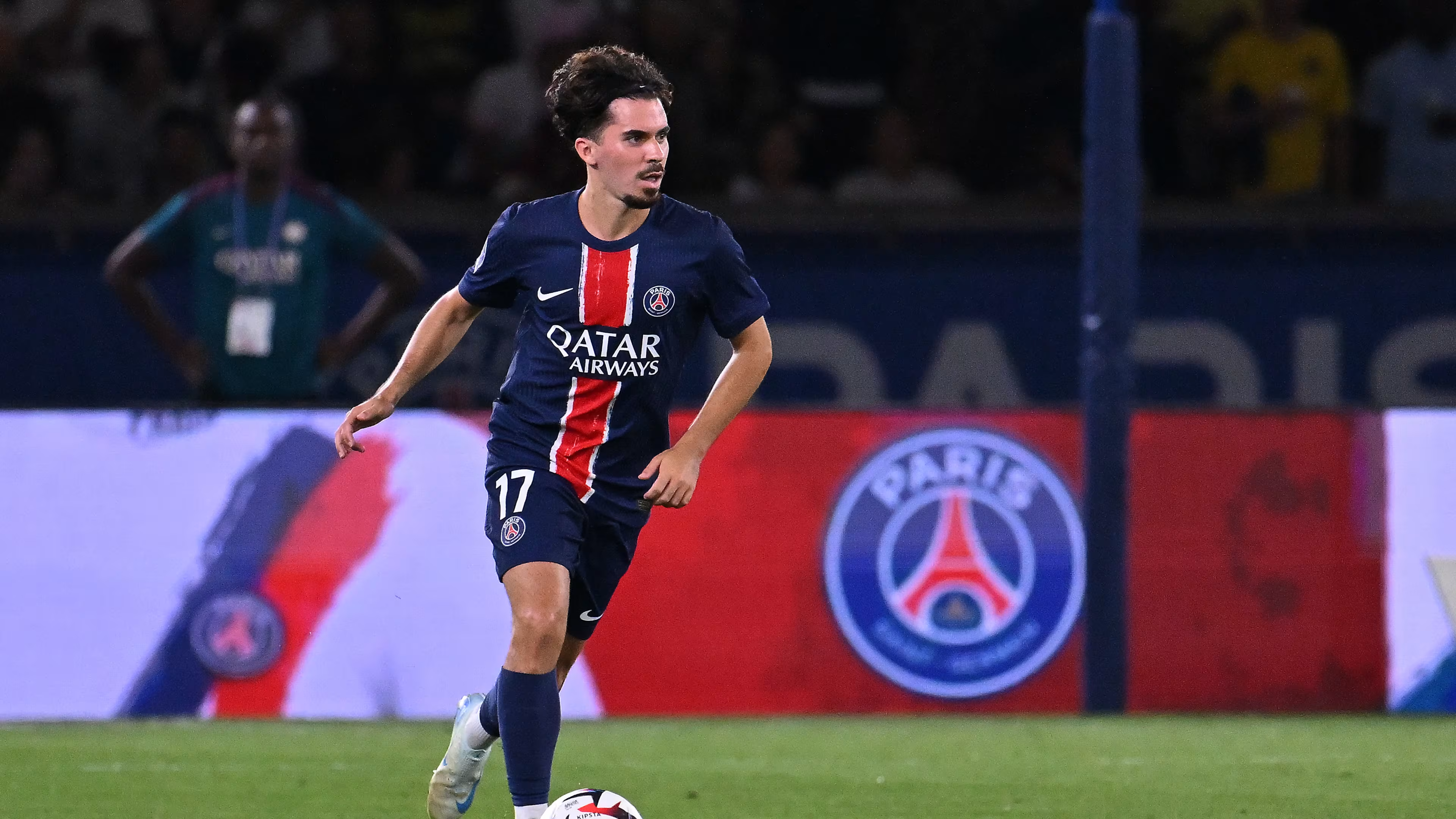
“To be honest, it actually worries me a bit! The age gap between the young players – like Ibrahim last year – and me is widening every year. But when I look back at my coaching career, I realise I’ve always managed to build good relationships with the players. I think that can continue, even with this age gap. I really enjoy laughing, joking and being close to the players. It’s something that gives me energy: connecting with them, cracking jokes, sharing moments together. I remember that Vitinha sometimes says to me: “I don’t know if you’re being serious or not.” And I tell him it’s up to him to figure it out! (Laughs.) I love this relationship. I love being able to help the players, but also to challenge them, to push them to react and to observe how they respond to what I say. Does this lead to something positive or negative? Every player needs a different approach, depending on the situation. Some need encouragement, others need a more demanding message. I try to find the best way to communicate with each one. It’s fascinating, and that’s what I love about my job. Everything is constantly evolving, just like our team, which is always on the move.”
You often pit your players against each other to push them to excel. But what about you – who do you compete against? Is it yourself? How do you challenge yourself on a daily basis?
“I’ve never been motivated by the idea of comparing myself to other coaches. Everyone follows their own path, and that’s something everyone should understand. Many coaches try to copy what works for others. For me, the most important thing is to keep following your own path. That means asking yourself questions. Is this how I want my team to play? Is this how I want them to lose, if they have to lose? That’s probably one of the hardest things for a coach to accept. But it is precisely the defeats that force us to question ourselves. I don’t need to motivate myself by looking at other managers. I have no intention of trying to improve my record or my CV simply to outdo them. I’m very happy with what I’ve achieved so far. I still have the ambition to win lots of trophies and to keep winning. But when the time comes to lose, we’ll have to accept it in the best possible way. There’ll be another team, another manager, another family, another club that will win and be happy. That’s life. You have to accept what happens, whilst giving 100 per cent of yourself.”
You often talk about the people who motivate you on a daily basis. How would you describe your staff – the men who surround you and support you every day?
“It’s obviously very important. I’ve been coaching for fifteen or eighteen years – I can’t even remember exactly – and I’ve worked with different people. Some have moved on, which is normal in this line of work. At the very highest level, we share so much. We travel together, we work together, we spend a lot of time in the same offices. There are also times when we get frustrated because things aren’t going as we’d like. Top-level sport is extremely tough. Winning is difficult, and the pressure is incredible. Every season brings its own set of challenges. But, ultimately, it’s the staff and the players who have to share these moments, try to understand one another and think together about how to improve. That’s what we’re trying to do.”
What makes your relationship with Luis Campos so strong?
“It’s something very difficult to explain, but I’ve been lucky enough to work with some very good sporting directors in the past. I particularly remember a recent conversation with my son Pacho. I reminded him of the day Luis Campos came to my house, at the start of our collaboration. He knew where I lived, he’d come to see me, and I remember that moment very clearly. With Luis, the connection was very clear right from the start. He was someone I didn’t really know yet, but I quickly sensed that he had confidence in me and that he wanted to achieve great things for the Club. That connection surprised me – in a good way. It was a very important moment for me. I’d had some great collaborations before, but this one is particularly strong. That’s the best way for a manager to work: having that trust and moving forward together.”
Your involvement also extends beyond the pitch, particularly through the Club’s community initiatives and its Foundation. Why is this commitment important to you?
“Right from the start, I met with the directors and learnt about the Club’s relationship with its foundation. We aim to help those in need, and that’s a wonderful thing. It’s a mission that belongs to the whole team and one we all share. The players are also very involved and stay in touch with the foundation. It’s very important to know that we have the opportunity to help others through football. We can play, do our job and, at the same time, make a difference to people in need. It’s very positive, and I think the Club sets a very high standard in this area.”
The Parc des Princes is a powerful symbol. Paris is a footballing city, with a passionate following. Did the chance to forge that bond with the supporters play a part in your decision to stay?
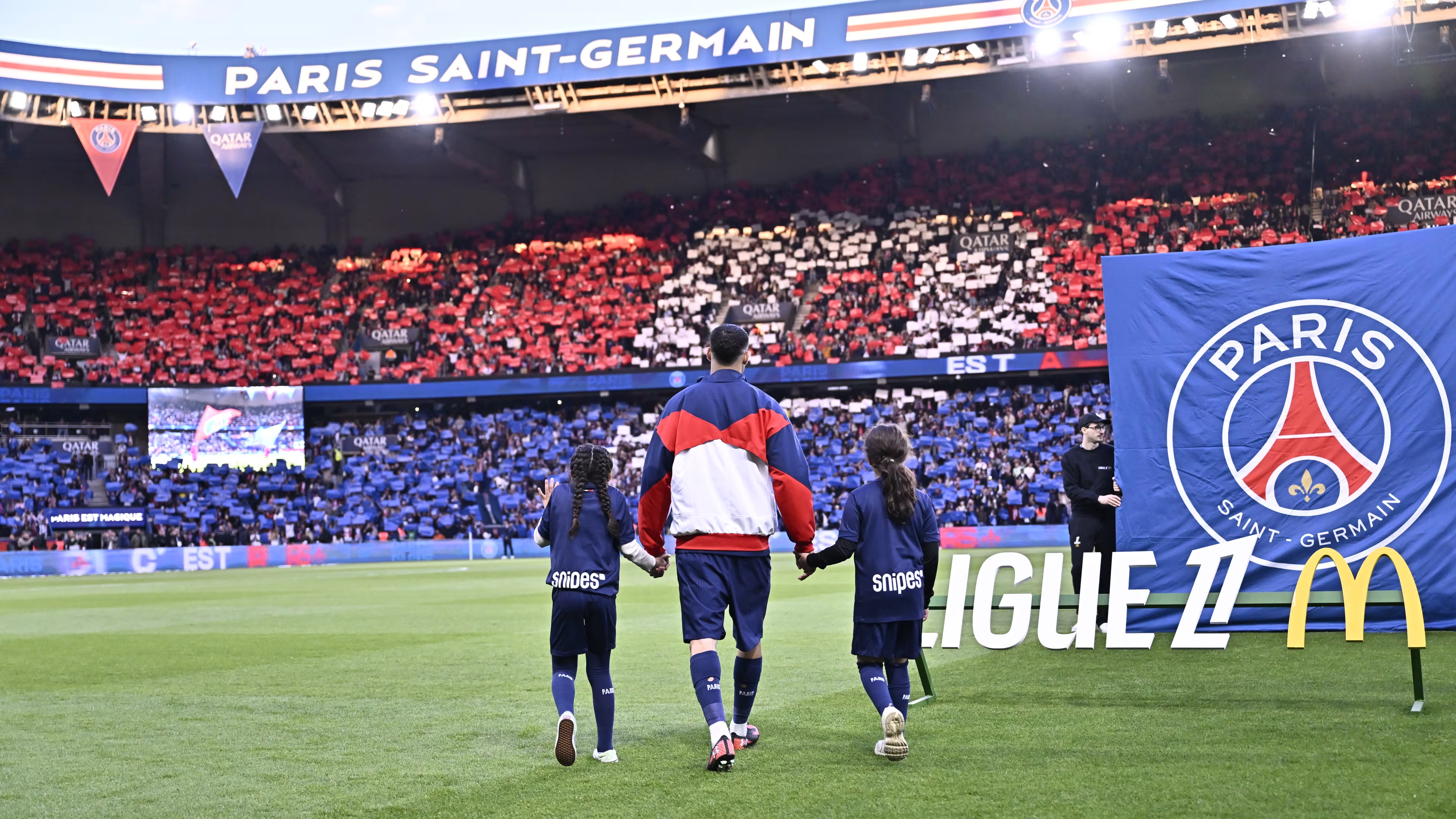
“Absolutely. It’s the first time I’ve experienced anything like it, and my reaction was: ‘Wow!’” There’s that banner during matches, in particular, and I’m also thinking of everything that happened around the Champions League final. It’s incredible. I can only say thank you to them. It’s a real pleasure. The supporters have always shown me a great deal of respect, including on a personal level, and that means the world to me. As a manager, it also means more pressure, because I want to keep improving and give them even more.”
So, coach, you’ve become a proper Parisian!
“I hope so! But I still have a long way to go with my French. The first few years were very difficult for me when I was trying to speak the language. At times, I felt as though I’d reached a dead end.
“But I’m making progress and I feel more and more at ease every day. I think it’s important to be able to convey what matters to this Parisian and French club, and to bring its culture to life. I’m a foreigner, but I want to connect with Paris and I hope to stay connected to this city for the rest of my life.”